
How to Search Civil Dockets
Big civil suits, family matters, divorces, and delinquent-tax cases in the 143rd Judicial District Court are filed with the Reeves County District Clerk. County Court at Law civil cases, probate, and guardianship files go through the County Clerk instead. Evictions and small claims land with the Justice of the Peace precinct. No single countywide portal is confirmed to cover every one of these Reeves County civil docket types, so know your venue first.
The statewide re:SearchTX portal gives you Cases and Hearings searches for courts that file electronically. You can look up a case by party, attorney, case number, or judicial officer, and a wildcard helps when a first or last name is unclear. Sort results by filing date or case number, newest or oldest. The local cause-number pattern is not published, so copy the exact number from a notice or pleading.
- Identify the court from the petition, citation, notice, or cause number.
- Select Cases and search by exact case number when it is known.
- For a name search, use the party field and available county or court filters.
- Open Case Details and review status, parties, filings, and hearings.
- Ask the correct clerk for a judgment or certified copy when the index is not enough.
When a case does not appear, contact the clerk directly by phone, email, visit, or letter. A blank statewide result has several explanations: old paper files, spotty integration, a restricted record, or simply the wrong court. Only the Reeves clerk can confirm which one applies. The portal cannot.
Two Reeves Civil Docket Routes
Civil cases in Reeves County take one of two routes, and picking the wrong one costs time. Major civil and family matters belong to the 143rd Judicial District Court. The District Clerk holds those files. County Court at Law cases go the other way. The County Clerk keeps them along with probate and guardianship records. Two counters, two search paths. Ask the County Clerk for a district divorce case and you will likely be sent across town. A District Clerk docket search will never surface a JP eviction.
| Civil matter | Court | Custodian |
|---|---|---|
| Major civil, family, divorce, delinquent tax | 143rd Judicial District Court | District Clerk, option 6 |
| County-level civil | Reeves County Court at Law | County Clerk, option 3 |
| Probate or guardianship | County-level court route | County Clerk, option 3 |
| Eviction or small claims | JP Precinct 1 through 4 | Named precinct clerk |
One warning about names. The constitutional Reeves County Court shows up in OCA verification material as administrative-only. The statutory County Court at Law is a different office entirely. It is the one handling civil filings. Getting the court name right is half the battle in a Reeves County civil docket search.
What a Civil Docket Shows
A Reeves County civil docket can show the cause number, location, case category, filed date, judge, status, and case style. Public parties and attorneys appear too. So do filings and hearings. Clicking through the re:SearchTX result description opens Case Details, where a chronological list may run from the original petition and service return through the answer, motions, orders, notices of setting, continuances, and judgment. The local portal may show a different slice of the file.
| Case number | The court-assigned identifier. Reeves publishes no universal format, so copy the actual number exactly. |
|---|---|
| Parties | Plaintiff or petitioner and defendant or respondent roles, with intervenors when public. |
| Filings | Petition, citation, return, answer, motion, order, and notices listed by date. |
| Hearings | Setting type, date, time, court, and reset history when integrated. |
| Outcome | Default, agreed, summary, or final judgment, dismissal, nonsuit, or other disposition. |
Some details live only in the filed order. Judgment amounts and balances often sit there. The public index does not show them. Adoption, protected family matters, sealed filings, and personal identifiers may be restricted as well. Treat Case Details as a map to the file, not the file itself.
Reeves Official Search Limits
For records the County Clerk holds, the County Clerk-linked Official Records Search is the published local online starting point. Be realistic about what it delivers. The landing page does not list a dependable set of civil case fields, and it does not demonstrate coverage of County Court at Law, probate, or guardianship dockets. Useful, yes. Complete, unproven.
Before relying on it, look at the official records page for the Reeves County search and see what that county-linked entry point actually displays.
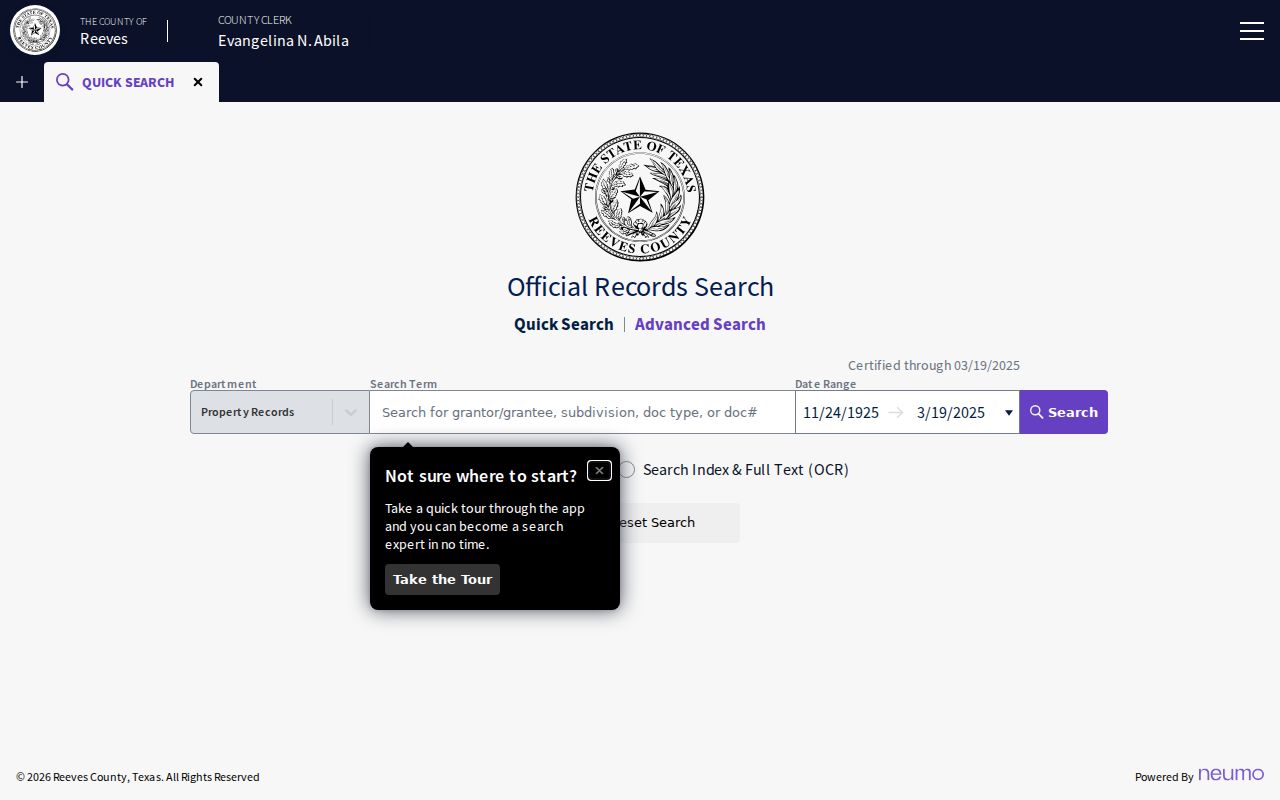
An existing interface is not proof that every civil court feeds it. Missing result? Call the County Clerk at 432-287-0222 option 3. For a 143rd District Court case, use the District Clerk at option 6 instead.
Note: The official label “all court records” sounds broad. It does not mean every Reeves JP or District Court civil docket is indexed there.
Types of Civil Cases on the Docket
The right Reeves County civil docket depends on the type of claim. OCA civil reporting sorts cases into broad categories. Those include contract, real property, tax, and injury or damage. Reeves clerk pages, meanwhile, point to family, divorce, delinquent tax, probate, and guardianship routes. Dollar limits that divide jurisdictions can change. The local court pages do not list them.
- District civil suits, including major contract, property, injury, and tax matters
- Family and divorce proceedings kept by the District Clerk
- County Court at Law civil cases kept through the County Clerk
- Probate and guardianship matters assigned to the County Clerk route
- Evictions and small claims filed with the correct JP precinct
Money at stake does not make a case civil. A city traffic citation belongs to Pecos Municipal Court or a JP. Which one depends on the venue that issued it. File in the wrong office and the case slows down. You also create a second search problem for yourself later.
Reeves Petition to Judgment
Every Reeves civil case starts with a filed petition or complaint. The clerk then issues a citation, and a return records service or attempted service. The other side may answer, waive, counterclaim, or file something else. Discovery notices and motions fill the middle of the docket. Later comes a scheduling order or notice. It sets a status conference, motion hearing, docket call, or trial.
Civil docket flow: Petition › Citation and Service › Answer › Motions › Setting › Judgment or Dismissal › Enforcement or Appeal
Resets and continuances stay in the history, so always read the most recent entry. A case can close in several ways. Those include bench or jury judgment, summary judgment, agreed judgment, default, dismissal for want of prosecution, or nonsuit. Afterward, the docket may show an abstract, writ, garnishment, satisfaction, or notice of appeal. Each of those entries carries a different legal effect.
Settings and Hearings on Civil Dockets
What should a hearing entry contain? The case, the setting type, the date and time, the court, and the judge or judicial officer handling it. re:SearchTX helps here. Its Hearings search lets you click a hearing type right in the results. Reeves County posts no standalone daily civil calendar, so call before you count on anything. For the 143rd Judicial District Court, the county's published contact covers the judge's office and the coordinator's channels. The District Judge's court coordinator remains a sure channel. So is the clerk handling the file. County Court at Law callers can pick option 2 for the court office. Option 3 reaches County Clerk records staff. Always give the cause number and setting type when you ask.
Settings change, and the docket keeps the history. A notice of setting may later be followed by a continuance or a reset. The old event stays on the civil docket even after it passes. Read forward to the newest date, then confirm with the court if you must attend. A scheduling order is different too. It sets deadlines rather than an in-court hearing date. The Reeves County court calendar walks through the fuller setting workflow.
Reeves Civil Docket Endings
Civil abbreviations can hide big differences. Reeves County publishes no local code sheet, so verify common OCA labels against the signed order itself. The docket shows which event was entered. The judgment shows what the judge actually ordered and what steps remain.
- DWOP
- Dismissal for want of prosecution, often used when a case has not moved forward.
- NS
- Nonsuit, generally the plaintiff's voluntary withdrawal, subject to the order's terms.
- DJ or DEFAULT
- Default judgment after the responding party did not complete a required response or appearance.
- AGJ or SJ
- Agreed judgment or summary judgment. Each rests on a different procedural basis.
- DISM
- Dismissal. Read the order to learn its scope and whether it is with or without prejudice.
A code never replaces the judgment. Need the outcome for another court? Ask the Reeves clerk for a certified copy. The clerk can also spot any later amended or post-judgment orders tied to the case.
Public Access to Civil Dockets
Texas civil court records are open as a rule, but not without limits. Texas Rule of Civil Procedure 76a presumes that covered records stay public. It permits sealing only under its own standards and exceptions. Adoption files remain closed through the Reeves District Clerk route. Other material may be withheld or redacted. That includes juvenile records, CPS files, protective orders, sealed material, and personal identifying details.
Access rule: A missing Reeves County civil docket can mean wrong venue, older paper storage, incomplete electronic integration, restricted status, or a search mismatch. It does not by itself show that no case exists.
Judicial records outside the case file fall under Texas Rule of Judicial Administration 12. The Texas Public Information Act states the broad state policy. Yet court case files are not handled exactly like executive-agency records. Send any case-document request to the clerk. The clerk keeps the action.
An index and a filed image are two different products, so treat them separately. re:SearchTX may require an account. It may also require a document purchase. Certified copies come from the Reeves clerk, not from an exported list of results.
Reeves Civil Copies and Fees
Both Reeves clerk offices follow the same practical copy chain. Give the court, cause number, and party names. Add the exact document, the filing date if you know it, plain or certified copies, your contact information, and a return address. Ask whether the file sits in an electronic system, an archive, or a paper folder. Then call ahead. Confirm the total, postage, and accepted payment.
| Item | Published amount | Meaning |
|---|---|---|
| Written or emailed copy | $1 per page | District Clerk and County Clerk copy schedule |
| Certification | $5 additional | Clerk certification added to the copy |
| District name search | $5 | Civil or criminal case name search |
| County civil filing | $350 | Filing fee, not a copy fee; costs vary |
| Probate or guardianship filing | $360 | Filing fee, not a copy fee |
The County Clerk works out of Suite 101, 100 E. 4th Street, Pecos, and takes mail at P.O. Box 867. The District Clerk sits on the courthouse second floor. Phone, email, counter service, mail, the county-linked portal, and the statewide portal together form the Reeves civil access chain.
Reeves Civil Docket Wildcards
The re:SearchTX guide allows an asterisk wildcard for party, attorney, and judge names. A full name or its punctuation may be uncertain. That makes a Reeves civil docket search useful. Filter further by county, court, date, and party role where offered. Remember, a wildcard is only a search aid. Confirm the court and cause number before you rely on any result.
Reeves Civil Docket E-Filing
Attorneys file Texas district and county civil, family, and probate cases through eFileTexas. It is not a public docket viewer. Your own filing history will not show the whole case either. The clerk still decides acceptance. The clerk also keeps the official Reeves civil docket file.
Reeves Civil Docket Transfers
A change of venue, a consolidation, or an appeal can shift later activity away from the first Reeves cause number. Watch for a transfer order. Also look for a notice of appeal, a clerk's record request, or a reference to a new court. Ordinary Reeves civil appeals go to the Eighth Court of Appeals at El Paso. The original clerk keeps the trial file. The appellate court opens its own docket.
Reeves Civil Docket Service Entries
A filed petition proves nothing about service. The return or waiver is the Reeves civil docket entry that records delivery or a recognized substitute. If service status controls your next step, inspect that filing rather than trusting the opening case date.
Reeves Civil Docket Document Access
A docket title in re:SearchTX may link to a purchasable image, while sealed or confidential images stay unavailable. Jot down the filing date and the document name. Those details let the Reeves clerk pull the paper or electronic item and quote the right copy fee.